Commercial Roof Systems We Service
Every commercial system fails in its own way. Knowing what to look for — and what it means — is the difference between a targeted repair and an unnecessary replacement.
TPO roofing
TPO lives or dies by its heat-welded seams. We inspect seams, flashings, penetrations, drainage, and the membrane surface for weld failures, punctures from foot traffic or debris, and shrinkage pulling the membrane back from edges and parapets. Failed seams can often be re-welded and punctures patched — replacement enters the conversation when seams are failing across wide areas, insulation underneath is saturated, or the membrane itself is at the end of its service life.
EPDM roofing
EPDM’s weak points are its adhered or taped seams, patches, edges, and penetrations — plus ponding water, which accelerates deterioration. We check all of them before recommending anything. EPDM is forgiving: many seam and flashing problems can be repaired with proper primers and flashing details. When shrinkage has pulled the membrane off parapets in multiple places, or ponding has compromised large sections, replacement is usually the honest answer.
Metal roofing
On commercial metal roofs we look for loose or backed-out fasteners, failed sealants at seams and penetrations, corrosion at cut edges and dissimilar-metal contact points, flashing problems, and storm damage. Hail dents the panels — the question is whether the dents broke the coating or opened seams, which is a functional problem, versus cosmetic dimpling, which usually is not. A surprising amount of metal roof trouble is isolated and repairable without touching the panels themselves.
Flat and low-slope roofing
These roofs depend on two things: sound drainage and carefully sealed transitions. We trace leak paths across the field, check drains, scuppers, and overflow paths for blockages, and inspect every curb, parapet, and penetration flashing. Ponding water that lingers more than a couple of days after rain is a red flag — it tells us the slope or drainage needs attention, not just the membrane.
Built-up and bitumen roofing
On built-up (BUR) and modified bitumen systems we inspect the surface for blistering, splits, and alligatoring, check seams and flashing details, and verify drainage. Small blisters and isolated splits can often be repaired. Widespread alligatoring or splits across the field mean the system is aging out, and patching becomes throwing good money after bad.
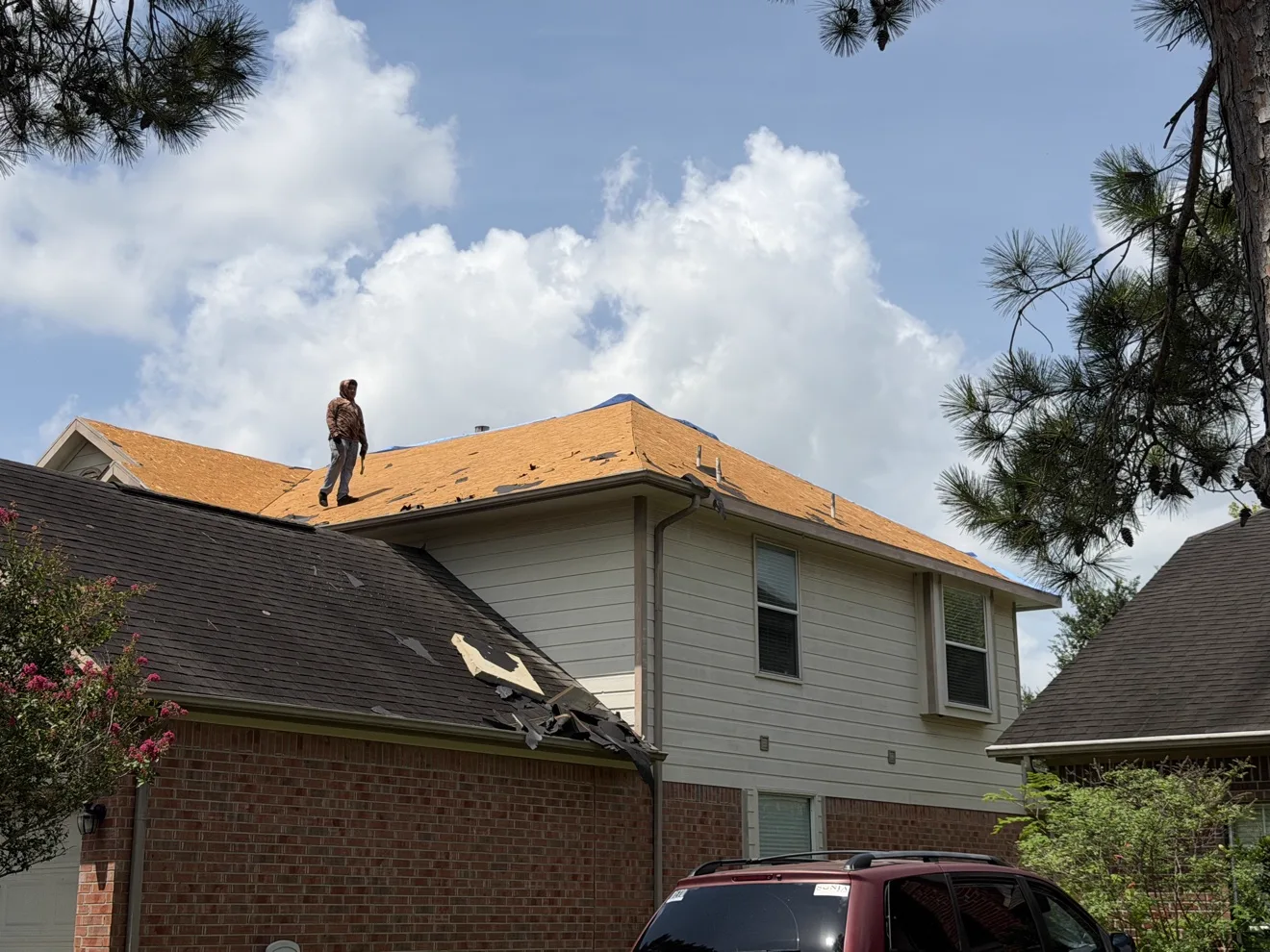
Tear-off in progress — our crew on the job.
How We Decide: Repair vs. Replacement
We run every commercial roof through the same honest framework before recommending anything:
- How much of the roof is affected? Isolated failures get repairs. System-wide failures get replacement.
- Is the insulation wet? Saturated insulation cannot dry out in place — it has to be replaced, and widespread wet insulation usually tips the math toward a new system.
- How old is the system, and what is its condition otherwise? A ten-year-old TPO roof with one bad seam is a repair. A twenty-five-year-old BUR with splits everywhere is not.
- What does the repair history look like? If you are patching new leaks every few months, the cumulative cost and disruption are already telling you the answer.
- What does downtime cost you? For an operating business, we weigh the disruption of repeated service calls against one planned replacement.
We show you the findings, the photos, and both options with real numbers. The decision is yours — our job is to make sure it is an informed one.
Finding Leaks on Commercial Roofs
On a commercial roof, the drip inside is rarely below the entry point. Water travels along the deck, follows seams, and drops through the path of least resistance — sometimes dozens of feet from where it got in. We trace backward: roof surface, seams, penetrations, flashing, drains, and scuppers, cross-referenced with interior staining. Methodical tracing beats guessing, and it is why our repairs hold.
Storm Damage Documentation
After hail or wind, we document visible damage with photos and measurements — membrane punctures, displaced flashing, dented metal, debris impact — and organize it for your insurance claim. We can meet your adjuster on the roof. Whether the claim is approved is always the insurer’s decision; we never promise an outcome, but we make the condition of the roof hard to misunderstand.
Emergency Response for Active Water Intrusion
Water coming into an operating building cannot wait for business hours. Call any time — active intrusion moves to the front of the line. We stop the water first with emergency measures, protect inventory and interiors, then come back with the full inspection and the permanent plan.
What You Get Before We Start
No work begins without a written scope: what we found, what we recommend, what it costs, how long it takes, and what warranty applies. For replacements, that includes the system, the assembly, and the schedule around your operations. You approve it in writing first — no surprises mid-job.